

 Introduction
The modern consumer is no longer driven purely by price or quality, sustainability and eco-consciousness now sit at the heart of purchasing decisions. From apparel brands touting “organic cotton” to cosmetic companies highlighting “cruelty-free” labels, the marketplace is overflowing with eco-friendly promises. However, the surge in sustainability marketing has also brought with it the problem of greenwashing—where businesses exaggerate or misrepresent the environmental attributes of their products. While such practices distort consumer choice and weaken genuine sustainability initiatives, they also highlight an overlooked challenge in trademark law: the regulation of marks and labels that imply eco-friendliness. The question today is whether the legal framework around trademarks is equipped to tackle the tension between authentic green branding and deceptive environmental claims.
Trademark Protection and the Rise of Green Branding
Trademarks serve as commercial identifiers, distinguishing the source of goods and services while safeguarding brand reputation. With consumers increasingly seeking environmentally responsible products, “green” marks, whether words like “eco-safe,” “biodegradable,” or logos with leaves and earthy tones, have become powerful branding tools. Yet, unlike conventional trademarks that simply signal origin, green trademarks carry an implicit environmental assurance. The challenge lies in determining whether such claims are genuinely substantiated or merely aspirational marketing language.
In India, the Trade Marks Act, 1999 provides certain safeguards that could, at least theoretically, curb misleading eco-marks. Sections 9(1)(b) and (c) bar the registration of descriptive marks that merely indicate the quality, intended purpose, or other characteristics of goods. Thus, terms such as “green,” “eco,” or “organic” are likely to be rejected unless the applicant demonstrates that the mark has acquired distinctiveness through extensive use. Section 9(2)(a) further prohibits the registration of marks that are deceptive or misleading. An “eco-friendly” label attached to a product laced with harmful chemicals, for example, could fall foul of this provision. Section 9(2)(b) also empowers refusal where the mark is contrary to public policy or morality, a principle that resonates with consumer protection and the broader public interest in advancing sustainability. Additionally, the Act recognizes certification marks, which are of particular relevance in this context. Marks such as the Ecomark, administered by the Bureau of Indian Standards, provide an assurance that goods meet verified eco-friendly criteria, thereby offering a structured framework for consumer trust.
On paper, this provision should be sufficient to address greenwashing. However, the line between puffery and deception is blurred. For instance, when a company markets a product as “eco-friendly” without providing measurable environmental credentials, is that an absolute misrepresentation or is it permissible exaggeration? The ambiguity creates a fertile ground for misuse, allowing brands to exploit consumer sentiment while staying just within the limits of legal acceptability.
Globally, the issue has been addressed unevenly. Jurisdictions like the European Union and the United States have developed consumer protection mechanisms and advertising standards that scrutinize environmental claims more rigorously. India, however, still lacks comprehensive statutory guidance specific to green trademarks. As a result, trademark law remains reactive rather than preventive, intervening only when disputes arise instead of providing a framework for pre-emptive regulation.
Greenwashing and the Risk of Consumer Deception
The primary concern with eco-friendly trademarks is the risk of misleading consumers into believing they are making environmentally responsible choices when they are not. As a result, genuine businesses that invest in sustainable practices find themselves competing with superficially “green” rivals who gain unfair advantage through marketing gimmicks.
Courts across the globe have started to recognize this problem. The Federal Trade Commission (FTC) in the United States, for example, has issued its “Green Guides” to help businesses avoid deceptive environmental marketing claims. These guidelines emphasize that vague and unqualified claims such as “eco-friendly” or “sustainable” are likely to be misleading without clear substantiation. In India, however, such regulatory clarity is missing. Although the Advertising Standards Council of India (ASCI) has set broad principles against misleading advertisements, its framework is voluntary and lacks statutory force. Currently, the Indian Trademark Registry does not demand proof of environmental claims unless challenged. This reactive stance shifts the burden of accountability to consumers and competitors, who may not always have the resources or expertise to contest deceptive green marks.
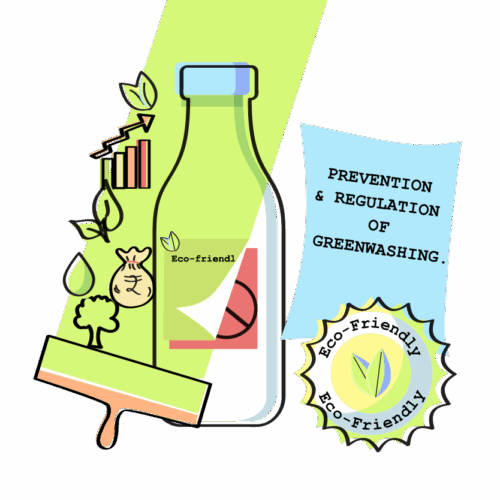
However, a significant development came in 2024, when the Central Consumer Protection Authority (CCPA) issued Guidelines for Prevention and Regulation of Greenwashing. These Guidelines define greenwashing as misleading environmental claims that exaggerate, omit or obscure facts, and they require that terms like “sustainable,” “eco-friendly,” or “green” be supported by verifiable evidence such as certifications or scientific assessments. They further mandate transparency for future-looking claims such as “carbon-neutral by 2030”, which must be backed by measurable action plans. Most importantly, they empower the CCPA to take action under the Consumer Protection Act, 2019, including the imposition of fines and orders to withdraw misleading advertisements. Although framed under consumer protection law, the Guidelines have a direct bearing on trademark practice, as brands can no longer safely adopt eco-marks without the ability to substantiate their environmental claims.
Bridging the Gap: Towards a Regulatory Framework for Green Trademarks
The need of the hour is a harmonized legal framework that recognizes the unique implications of eco-friendly trademarks and prevents their misuse. Trademark law in its current form was not drafted with sustainability marketing in mind and therefore fails to capture the nuances of environmental claims. A solution could involve embedding environmental substantiation mechanisms within the trademark registration process. For instance, applications for green trademarks could require disclosure of certifications, third-party audits or compliance with recognized eco-labeling standards. This would align India with international best practices, such as the European Union’s eco-label scheme.
Further, there is scope for legislative collaboration between trademark authorities and environmental regulators. Instead of treating sustainability solely as a consumer protection issue, Indian law could recognize it as a hybrid concern involving both intellectual property and environmental governance. For example, if a company applies to register a mark with words like “biodegradable” or “carbon-neutral,” the Registrar of Trademarks could seek validation from environmental bodies before granting protection.
At the enforcement level, competition law could also play a role. Misleading environmental branding can distort fair competition by giving deceptive players undue market advantage. Collaboration between the Competition Commission of India (CCI) and the Trademark Registry may help curb systemic greenwashing. Moreover, incorporating stricter penalties for proven greenwashing under consumer protection statutes would act as a deterrent.
Importantly, these measures should not be seen as barriers to branding innovation. Companies genuinely committed to sustainability stand to benefit from a transparent and credible framework. Stronger laws would help them differentiate themselves more effectively, while consumers could purchase with greater confidence. Ultimately, such reforms would strike a balance between encouraging sustainability-driven branding and deterring opportunistic misuse of environmental consciousness.
Conclusion
Trademarks are powerful communicators of brand identity, but when used carelessly, they can also be powerful vehicles for deception. In the age of sustainability, the stakes are higher, where consumers rely on eco-branding to make ethical choices and misleading marks can erode both consumer trust and environmental progress. India’s Trade Marks Act, along with the recent CCPA Guidelines, provides a framework to curb greenwashing, but enforcement gaps remain.
The future of green branding in India lies in striking the right balance i.e, protecting consumers from deception, incentivising genuine sustainability and ensuring that eco-friendly trademarks are more than just marketing gloss. Only then will trademarks in the “green era” serve their true purpose, guiding consumers accurately while serving a marketplace where sustainability is real, not just rhetoric.