
Yin & Yang
Sabarimala: Gender Rights vs Religious Autonomy
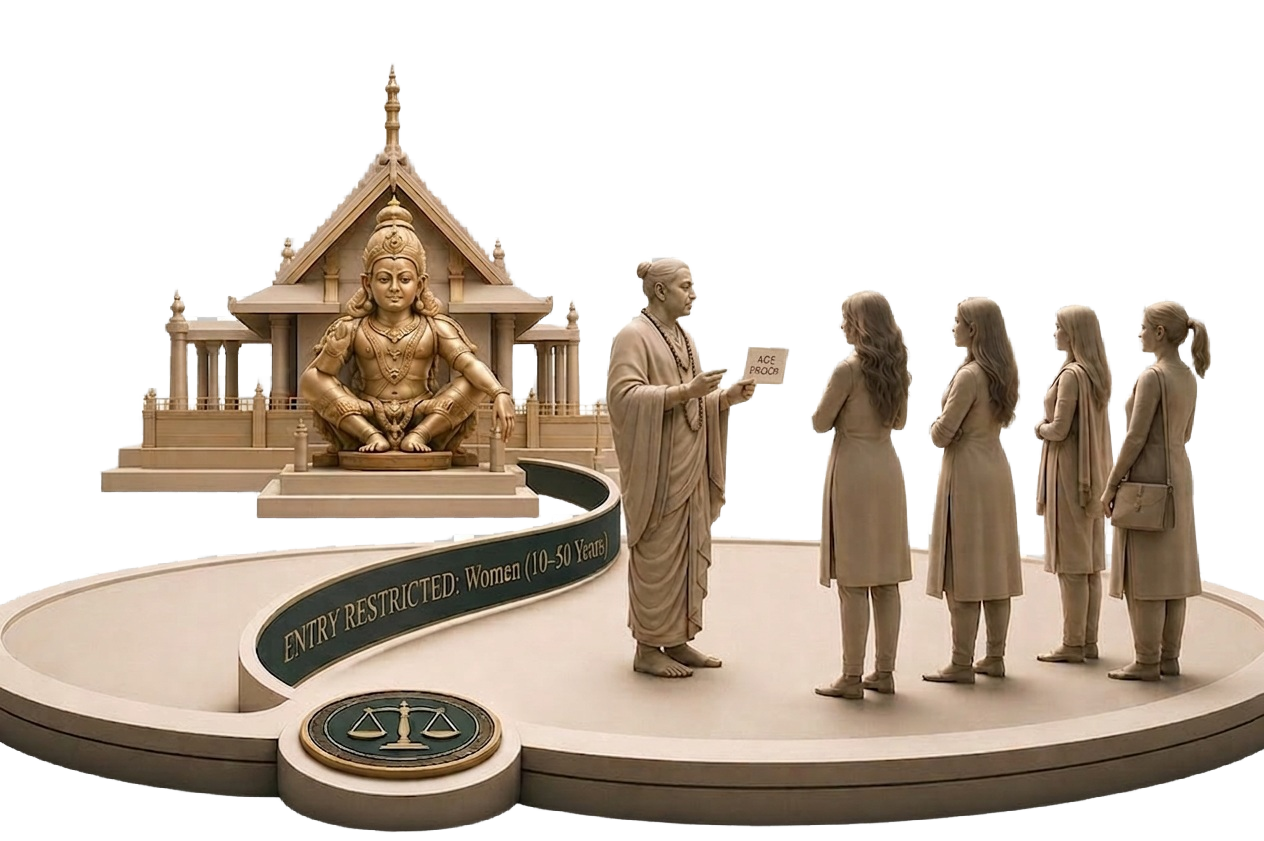
On 28th September 2018, in the Indian Young Lawyers Association & Others Vs The State of Kerala & Others, the Hon’ble Supreme Court pronounced a landmark judgment lifting the ban on the entry of women of all ages into the Sabarimala Temple. The centuries-old custom of excluding female worshippers between the ages of 10 and 50 from entering the Sabarimala temple was rendered unconstitutional.
The court struck down Rule 3(b) of the Kerala Hindu Places of Public Worship (Authorisation of Entry) Rules, 1965 on grounds of :
- violating Articles 25(1) (freedom of religion) and 15 (prohibition of discrimination on grounds of religion, race, caste, sex, or place of birth) of the Indian Constitution.
- Such exclusion not being an essential religious practice.
The impact
The judgment created widespread social and political unrest, triggering debate about judicial involvement in sensitive issue such as age-old religious customs, practices and beliefs but stirred a prolonged nationwide debate on the extent to which religious practices can override the fundamental rights guaranteed by the Constitution and vice versa.
Background
- The ‘Sabarimala Sree Dharma Saastha Kshethram’ [Temple] is a centuries old temple situated in the hilly district of Pathanamthitta in Kerala, the presiding deity of which is Lord Ayyappa.
- The temple, administered by the Travancore Devaswom Board [TDB] is open for pilgrims only for limited periods in November, December, January and April, besides the first few days of every Malayalam month.
- Lord Ayyappa being a ‘naisthika brahmachari’ i.e. ‘lifelong celibate’, any pilgrim visiting this Temple should compulsorily practise strict celibacy for 41 days before entering the Temple.
- For the same reason of the Lord being a ‘lifelong celibate’, it has been the centuries old tradition that entry to ‘menstruating’ women between the ages of 10 and 50 is strictly prohibited. Girls below the age of 10 and women above the age of 50 are, however, allowed to freely enter the Temple.
- In 2006, a group of lawyers – Indian Young Lawyers Association and several other individuals filed a Public Interest Litigation [PIL] petition directly in Supreme Court (under Article 32 that guarantees the right to seek constitutional remedy whenever a fundamental right is violated) challenging this tradition of prohibiting entry to menstruating women and praying for entry to women of all ages into the Temple.
- In September 2018, a 5-judge bench of Supreme Court pronounced a 4:1 verdict [Verdict] which declared the practice of prohibiting entry to menstruating women as violative of laws of equality, liberty and gender discrimination of individuals. Consequently, women of all ages have been entering the Temple.
- Since then, more than 50 Review Petitions have been filed in Supreme Court by various religious groups seeking review of its verdict. There have also been public demonstrations protesting against the verdict.
The 2018 ruling caused deep legal friction regarding the balance between the individual right to equality (Article 25) versus the right of religious denominations to manage their own affairs (Article 26). In February 2026, the Supreme Court decided to review its own verdict. Presently, all petitions have been referred to a 9-Judge bench for ‘review of its original verdict’ with a broader ambit of legal issues involved.
The core issues raised in the 2006 PIL and 2018 SC judgment
PIL of 2006 and SC verdict in 2018 have raised several social, moral and constitutional issues, leading to SC deciding to review its own verdict. Fundamental among these PIL issues can be identified as:
- Can “freedom of a religious institution to manage its own affairs in matters of religion” [Article 26] take precedence over an individual’s fundamental rights like “equality; discrimination; untouchability; religious freedom” [Articles 14, 15, 17, 25]?
- Can devotees of the Temple be regarded as a ‘separate religious denomination’ thus allowing them to manage their affairs in their own manner even if they are discriminatory in nature?
- Can prohibition of menstruating women in the Temple be accepted as an ‘essential religious practice’?
Let’s look at the ‘Yin and Yang’ of the Sabarimala judgment.
Rationale behind why menstruating women CAN be allowed entry into the Temple:
- Prevention of women from entering the Temple is per se violative of their fundamental constitutional rights that (i) prohibit discrimination on grounds of gender, under Article 15 and (ii) give them freedom to practise their religion, under Article 25.
- Treating menstruating women unfit for entering the Temple since they are deemed ‘impure’ during the menstruation period is violative of Article 17 that prohibits ‘untouchability’ in any form or manner.
- The Temple being a declared public place of worship for Hindus, it is open for worship by all sections of Hindus. The Kerala Hindu Places of Public Worship (Authorisation of Entry) Act 1965 [KHPPWA] too guarantees this right to all denominations of Hindus.
- Devotees of the Temple are Hindus; they hence cannot be regarded as a separate ‘religious denomination’ and hence do not have the right to impose their own practices of worship, especially those that infringe or impair the fundamental rights of individuals as guaranteed in the Constitution.
- Exclusion of women, including menstruating women, is certainly not an ‘essential religious practice’ of the Hindus that can be permitted under Article 26, nor is it an ‘integral part’ of their religion.
- The very practice of preventing entry of women, even during their menstruation period, is representative of a patriarchal mindset that has no place in an evolving, modern society.
Reasons why menstruating women CANNOT be allowed entry into the Temple:
- There is no blanket ban on entry of women of any age into temples of Lord Ayyappa across the country. It is only in this temple that entry for women of a specific age group has been prohibited, based on a religious tradition that has been in existence for a long period of time. As such, no wilful violation of Articles 14 or 16 that guarantee ‘equality before law’ can be attributed to this practice.
- Lord Ayyappa presides over this Temple in the form of a ‘naisthika brahmachari’ i.e. ‘lifelong celibate’. It is purely out of reverence for the Lord’s ‘lifelong celibacy’ and respect for the religious sentiments of the devotees that menstruating women alone have been disallowed entry. Therefore, viewing this practice as violative of Articles 15 or 17 on gender discrimination or untouchability would be prejudiced.
- Even though there have been instances in the long past of women having entered the Temple, it has been an ‘essential religious practice’ of this Temple in the recent past of not allowing menstruating women to enter it. This is in accordance with Article 26 as well as the KHPPWA that allow the Temple to manage its affairs in its own manner without State’s interference.
- Even though they are Hindus, devotees of the Temple can indeed be regarded as a separate ‘religious denomination’ by virtue of their unique prerequisite practice of following celibacy for 41 days as an act of catharsis/self-purification before entry. They thus can avail the freedom given under Article 26 to manage their affairs in their own manner without attracting conditions of ‘public order, morality or health’.
- From a legalistic angle, it can be argued that Article 15 (2) does not specifically include ‘places of worship’ in its ambit of areas and places where discrimination of any kind is prohibited. As such, this Temple cannot be regarded as being discriminatory by prohibiting entry to only menstruating women.
- Article 17 was framed specifically to abolish ‘untouchability’ once practised by upper ‘castes’ in Hindus. Applying this Article to the ban on entry of a specific group of women would be judicial overreach.
The 2026 Review of original verdict must address the following larger fundamental issues:
- Whether matters of religious faith can be subjected to legal scrutiny and adjudication in courts?
- Whether an individual’s right to equality overrides a religious group’s right to autonomy?
- Whether the ‘morality’ applicable to matters of religion should be ‘constitutional’ or ‘religious?
- Whether individuals or groups not belonging to the religion in question have the locus standi to challenge its practices through a Public Interest Litigation?