
in focus
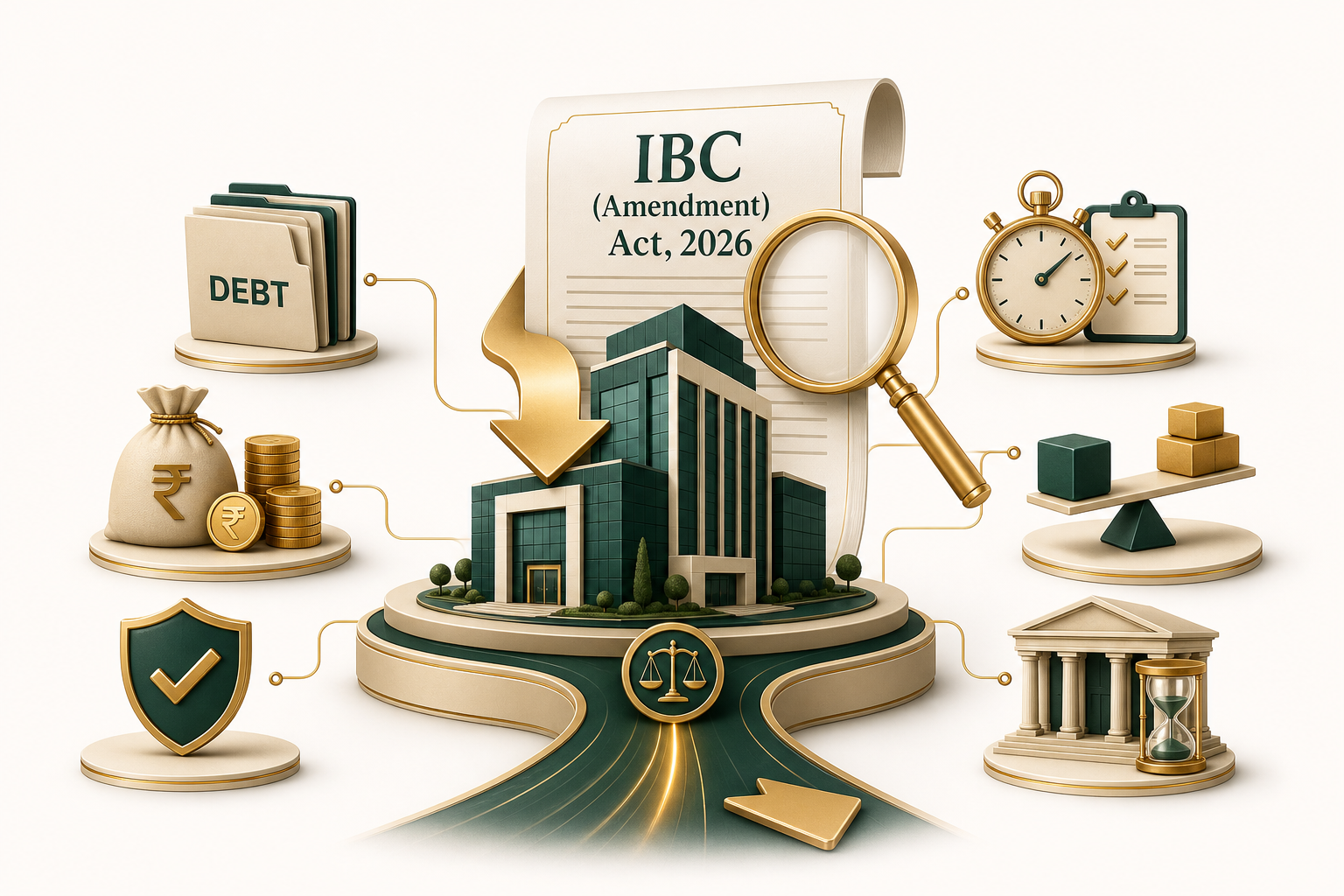
IBC (Amendment) Act, 2026 - Recalibrating Corporate Insolvency in India
On April 6, 2026, India got a brand-new version of its insolvency law. The Insolvency and Bankruptcy Code (Amendment) Act, 2026 was published in the official Gazette, and most of its provisions came into force from May 22, 2026, through a notification by the Ministry of Corporate Affairs. This is being called the biggest change to the IBC since it was first introduced in 2016. This one is different it touches almost every stage of the insolvency process: how a case gets admitted, how companies can settle disputes early, how assets are valued, and how creditors can recover money from bad transactions. At the same time, the Insolvency and Bankruptcy Board of India (IBBI) the regulator that makes the detailed rules issued several new regulations in May and June 2026 to support these changes on the ground. This article explains the key changes in simple terms, what they mean for companies, and how recent Supreme Court judgments are shaping the way these changes will actually work in practice.
Faster Admission of Insolvency Case
Earlier, even if a company clearly owed money and had defaulted, the NCLT (the tribunal that handles insolvency cases) had some discretion to delay or refuse to admit the case. This discretion was often used by companies to drag out proceedings. Under the 2026 Amendment, once a creditor proves that a default has happened and the basic legal requirements are met, the tribunal must admit the case. There is no more room for delay at this first stage. If the company defaults on a loan or payment, insolvency proceedings can start much faster than before. Boards and management teams need to be more proactive about managing defaults early, rather than relying on procedural delays.
A New Route : Creditor – Initiated Insolvency Resolution Process (CIIRP)
The Amendment creates a brand-new chapter in the law (Chapter IV-A) that allows creditors to start a resolution process on their own, called the Creditor-Initiated Insolvency Resolution Process (CIIRP). Until now, the main way to start insolvency was for a creditor or the company itself to approach the NCLT. CIIRP gives creditors an additional, more direct route. Creditors now have more tools and more control over how quickly they can act when a company defaults. This shifts some of the initiative away from the company’s management.
Pre-Packaged Insolvency (PPIRP) – No Longer just for MSME’s
Pre-Packaged Insolvency Resolution Process (PPIRP) is a faster, less disruptive way to resolve insolvency. The idea is simple: instead of going through a long, open-ended bidding process, the company and its main creditors agree on a resolution plan before approaching the tribunal. The plan is then filed along with the insolvency application itself. Until now, only Micro, Small and Medium Enterprises (MSMEs) could use this route. The 2026 Amendment opens up PPIRP to a much wider category of companies. The IBBI has also issued the PPIRP (Amendment) Regulations, 2026 (notified in February 2026) and new standard formats for PPIRP filings, so that documents filed before the NCLT are uniform and there is less confusion about paperwork. Larger companies facing financial trouble now have access to a quicker, more controlled way to restructure provided they can get their main lenders on board with a plan in advance. This can save time, cost, and reputational damage compared to a full-blown insolvency process.
Clearer Rules on Valuation
One of the most common reasons for court disputes during insolvency was: whose valuation of the company’s assets should be trusted? The 2026 Amendment fixes this by inserting a clear definition of “Registered Valuer” directly into the Code, and this definition is linked to the existing framework under the Companies Act, 2013. This means there is now one consistent standard for who is allowed to value assets and how that valuation should be treated in resolution plans. This ensures less time wasted in court arguing over which valuation report is correct. Resolution plans should move faster because valuation disputes is a major source of delay that should be reduced significantly.
Stronger Tools to Recover Money from Bad Transactions
Before a company goes into insolvency, sometimes its promoters or management move assets around in ways that are unfair to creditors like selling assets cheaply to related parties, paying off favoured creditors first, or simply trying to hide value. These are called “avoidance transactions”, it is a preferential, undervalued, or fraudulent transactions. The 2026 Amendment strengthens the tools available to creditors and resolution professionals to identify and reverse these transactions, and extends the “look-back” period (the time window during which past transactions can be examined) to two years. It also introduces penalties for parties who file frivolous or baseless avoidance applications, so this tool is not misused either. Directors and promoters need to be far more careful about transactions made in the period leading up to financial distress. Anything that looks like it was designed to move value out of the company even if done with good intentions could now be examined and potentially reversed for up to two years back. Boards should keep proper records and rationale for all significant transactions.
Changes to the Liquidation Process
If a company cannot be revived and ends up in liquidation, the 2026 Amendment makes several changes such as, the Committee of Creditors (CoC), the group of lenders who control decisions during insolvency now has the power to choose or replace the liquidator with a 66% vote. There are clearer rules for early dissolution of companies that clearly have no value left, so that time isn’t wasted on a long liquidation process for an empty shell. In some cases, a company can go back into the resolution process (CIRP) even after liquidation has started, if a better option becomes available. The Amendment also changes how a dissenting financial creditor (one who voted against the resolution plan) is paid their payout will now be based on a “lower of” calculation method, which is more standardised than before. The liquidation process should move faster and avoid getting stuck with companies that have no assets left. For lenders, this gives more control and flexibility over how the final stages of insolvency are handled.
Cross-Border Insolvency Gets a Framework
For the first time, the Code now has provisions (new Sections 240B and 240C) that allow the government to set up a system for cross-border insolvency in situations where a company’s assets, creditors, or operations span more than one country. The Indian companies with overseas assets, or foreign companies with assets in India, will eventually have a clearer legal pathway for coordinating insolvency proceedings across borders. The detailed rules are still to be notified.
More Powers for the Regulator (IBBI)
Alongside the Amendment Act, the IBBI issued several new regulations in May and June 2026 are:
- Inspection and Investigation (Amendment) Regulations: give IBBI clearer and stronger powers to inspect and investigate Insolvency Professionals (IPs), with an updated framework for penalties and suspensions.
- New Guidelines for Insolvency Professionals (May 18, 2026): set out how IPs are recommended for roles such as Interim Resolution Professional, Resolution Professional, Liquidator, and Bankruptcy Trustee.
- CIRP and Liquidation Process Amendment Regulations (June 2, 2026): update procedural rules around the CoC, disclosures by operational creditors, approval of costs, and how resolution plans are evaluated.
Insolvency Professionals, who effectively run the company during CIRP will now operate under tighter scrutiny. Companies and creditors dealing with IPs can expect more accountability, but also possibly more procedural formality.

What the Courts Are Saying: Three Important Judgements from 2026
While the Amendment pushes for speed and finality, the Supreme Court has been sending a parallel message in 2026: speed cannot come at the cost of fairness, and once a process is final, it stays final. Three recent judgments show this clearly.
a) IBC Cannot be used to recover debt
Dhanlaxmi Bank Limited v. Mohammed Javed Sultan & Ors. (2026 INSC 460)
In this case, a bank had given a loan to a company, but the loan amount was paid directly to a builder under a four-party agreement not to the company itself. When the company defaulted, the bank tried to use the IBC to start insolvency proceedings against it. The Supreme Court said no. The Court held that the IBC is meant to be a collective process to resolve genuine financial distress not a shortcut for one creditor to recover money in what is really a contractual dispute. If the real issue is a commercial or property dispute dressed up as a default, the IBC is not the right tool.
b)Once the Creditors Approve a Plan, There’s No Going Back
Sanjay Dave v. Andhra Bank Ltd. & Ors. (2026 INSC 580)
This case involved a company called Oracle Home Textiles. The promoter, Mr. Sanjay Dave, submitted a resolution plan that the Committee of Creditors approved with almost 100% support. But later, when the formal Letter of Intent was issued, Mr. Dave argued that it contained conditions he hadn’t agreed to, and tried to back out or renegotiate.The Supreme Court firmly rejected this. It held that once the CoC has approved a resolution plan using its commercial judgment, the successful bidder cannot turn around and renegotiate or withdraw even by claiming the final letter was conditional. The plan becomes binding and irrevocable. Because the bidder failed to honour the approved plan, the company was sent into liquidation.
c) Strict Timelines for Appeals
CA Ramchandra Dallaram Choudhary v. Adani Infrastructure and Developers Private Limited (2026 LiveLaw (SC) 611)
This case was about something more procedural, but equally important. Under the IBC, a party has 60 days (45 days, plus a possible 15-day extension) to file an appeal to the Supreme Court against an NCLAT order. If the appeal is filed with some defects, there is a further 28-day window under Supreme Court Rules to fix those defects. In this case, the appeal was filed on time but had defects. The defects were not fixed within 28 days instead, the party took 82 extra days and then asked the Court to excuse the delay. The Supreme Court refused. It held that once both the 60-day window (under the IBC) and the 28-day defect-curing window (under Supreme Court Rules) are over, the right to appeal is gone forever, permanently. There is no scope for the Court to revive it, no matter how good the excuse is. The Court was clear that procedural rules cannot be used to soften the IBC’s strict deadlines.
Conclusion
The IBC (Amendment) Act, 2026 is a major step toward making India’s insolvency process faster, more predictable, and more creditor-friendly. Mandatory admission, an expanded PPIRP, clearer valuation rules, a stronger avoidance toolkit, and tighter regulatory oversight of insolvency professionals are all aimed at one goal: resolving financial distress quickly and fairly. At the same time, 2026’s Supreme Court judgments show that courts will continue to insist on genuine financial distress and not on disguised contractual disputes, finality of approved plans, and strict adherence to timelines including for appeals. The biggest practical challenge that remains is capacity the Supreme Court itself has flagged shortages of judges and technical members at NCLT benches. Even the best-designed law can only move as fast as the tribunals applying it.