
clause & effect
The Foreign Contribution (Regulation) Amendment Bill 2026
The Foreign Contribution Regulation Act 2010 regulates the acceptance and utilisation of foreign contribution by individuals, associations and companies. Such contribution could be by way of donation or transfer of foreign currency, security or any article by a foreign source including but not limited to foreign individuals, companies, trusts, societies and even foreign government. On 25th March 2026, The Foreign Contribution (Regulation) Amendment Bill 2026 (‘FCRA’) was introduced in the Lok Sabha with the objective of further streamlining the acceptance, utilisation, regulation and management of foreign funds in India.
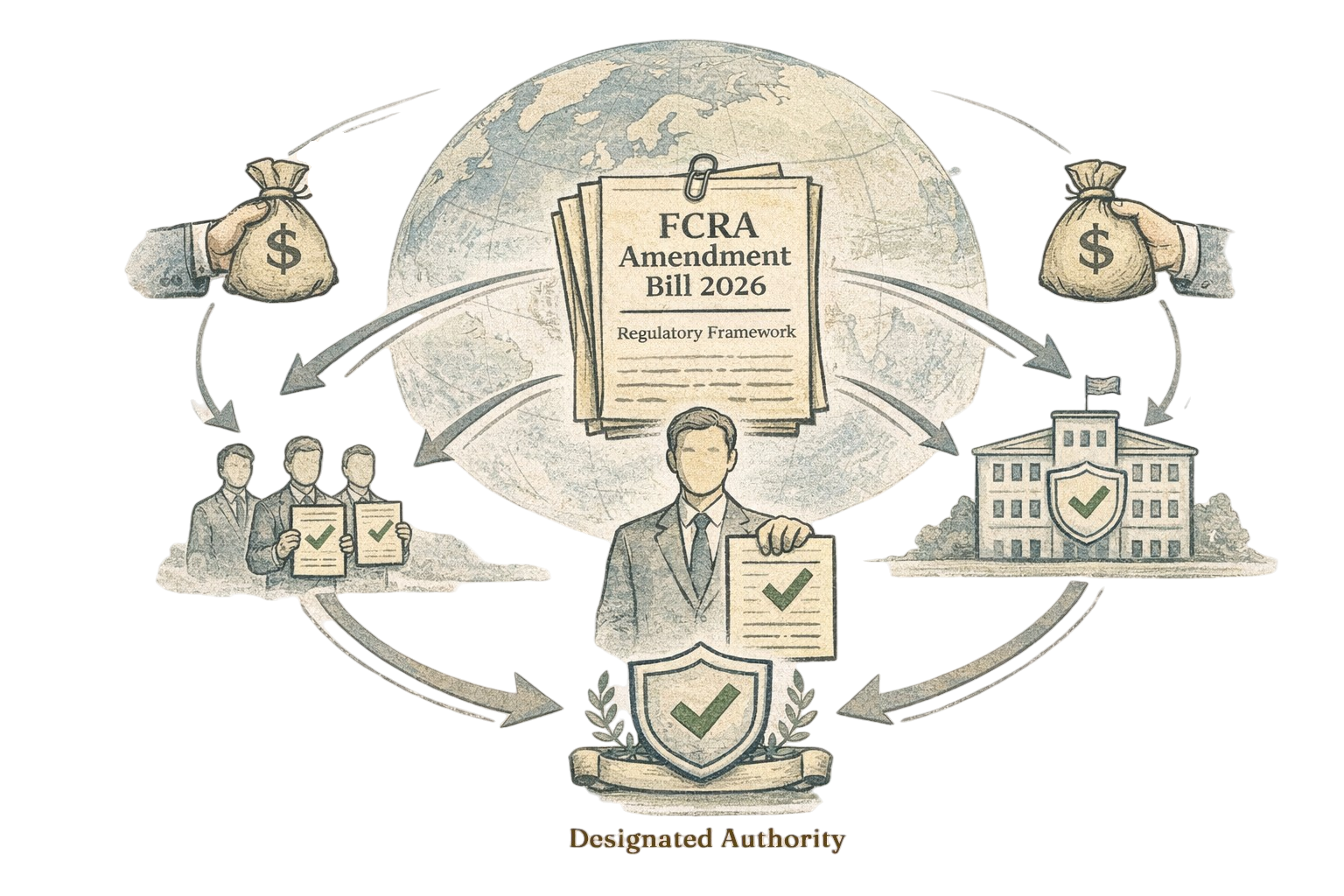
The highlights of the proposed amendments:
- Key Functionary: The Bill expands the ambit of “key functionary”, in relation to a person other than an individual to include— (i) the Director of a company; (ii) a partner in a firm; (iii) a trustee of a trust; (iv) the Karta of a Hindu undivided family; (v) an office bearer, member of the governing body, managing committee or other controlling authority of a society, trust, trade union or association of individuals; and (vi) any other officer or person, by whatever name called, who has control over, or responsibility for the management or affairs of such person.
- Additional grounds for cessation / cancellation /suspension of registration: The FCRA prescribes mandatory registration for certain persons with the central government for accepting foreign contribution. The Act allows for such persons to surrender the registration as well.
The Bill provides for additional grounds for cessation of registration. Registration certificate will be deemed to have ceased if: (i) no application for renewal was made, (ii) renewal has been denied, or (iii) renewal is not obtained before expiry.
License Cancellations & Suspensions
4,991 to 16,000
Active Associations
₹22,000 crore
Financial Inflow Annually
21,933
Cancelled Licenses
15,000
Expired Licenses
450
Suspended Licenses in fy 25-26
Total Fines Collected: ₹185 crore
3. Creation of Designated Authority to manage assets / foreign contribution: In cases of cancellation, surrender, or cessation of registration certificate, the Bill proposes that management of foreign contribution and assets created out of foreign contribution will vest provisionally in the ‘Designated Authority’ notified by the central government. This will also cover assets created partly from foreign contribution. The Authority will supervise and maintain the assets.
Temporary vesting with designated authority: The Designated Authority may utilise foreign contribution to manage the assets and related activities and return unutilised contribution and assets upon renewal or restoration of registration, or issuance of fresh registration.
Permanent vesting with designated authority: Where, (i) the concerned person fails to obtain a fresh registration or get the registration renewed or restored within a prescribed period, or (ii) where a person who was previously permitted to accept foreign contribution, ceases to exist or is rendered inoperative or defunct, the Designated Authority shall be permanently vested with the authority to apply the foreign contribution and assets for public purposes. This could be effected by transferring assets to ministries /departments / agencies of central, state, or local governments. The designated authority may also sell the assets and credit such proceeds along with unutilised funds to the Consolidated fund of India.
The central government has the power to exempt certain persons from vesting of foreign contribution and assets if necessary or expedient in public interest.
The 2026 Shift: Asset Vesting Impact
The 2026 Bill introduces Government-Vested Assets
1,200+ Properties
Targeted Assets
> ₹5,000 crore
Valuation of Seizable Assets
4. Prohibition on accepting foreign contribution: Under the Act, certain persons are prohibited to accept foreign contribution – political parties, candidates standing for elections, Judges, legislators, news publishers, associations or companies engaged in production or broadcast of news or current affairs programmes. The 2026 Bill expands this category to prohibit any “person” engaged in these activities.
5. Penalties and trials: The FCRA imposed penalty and maximum imprisonment of 5 years. The Bill proposes to reduce the imprisonment period to 1 year with the objective of ensuring quicker trials and faster resolution of cases by imposing penalties.
6. Appeals: Any person aggrieved by the order of the designated authority can appeal to the District Judge within 90 days.
Though the Bill was just introduced in the Parliament, there has been concern amidst the NGO sector especially about the introduction of ‘Designated Authority’ that could lead to the state takeover of private assets. While the government rationalizes the Bill as a necessary step to protect national sovereignty and prevent the “misuse” of foreign funds and assets. It is a delicate balance to be maintained.
For full text of the Bill refer:
https://prsindia.org/files/bills_acts/bills_parliament/2026/Foreign_Contribution_Bill_2026_Text.pdf