
Yin & Yang
Euthanasia: Legal Lifeline to Death
LEGAL MILESTONE
On 11th March 2026, in the Harisha Rana & Ors Vs Union of India & Ors case, the Hon’ble Supreme Court of India set a historic precedent by allowing the family of a young man in permanent vegetative state to discontinue the Clinically Assisted Nutrition and Hydration (CANH), on which he was entirely existing on.
This judgment expressly included right to die with dignity as a fundamental right under Article 21 of the Indian Constitution.
EUTHANASIA
Also known as ‘mercy’ killing, it is the act of intentionally terminating the life of a human being suffering from any medical condition in which
i) the person is in a ‘coma’ or ‘vegetative state’ i.e. the person’s brain does not function normally and consequently deprives him of consciousness, awareness and normal movements; and
ii) the person does not respond to any treatment provided over a period i.e. the condition is ‘incurable’.
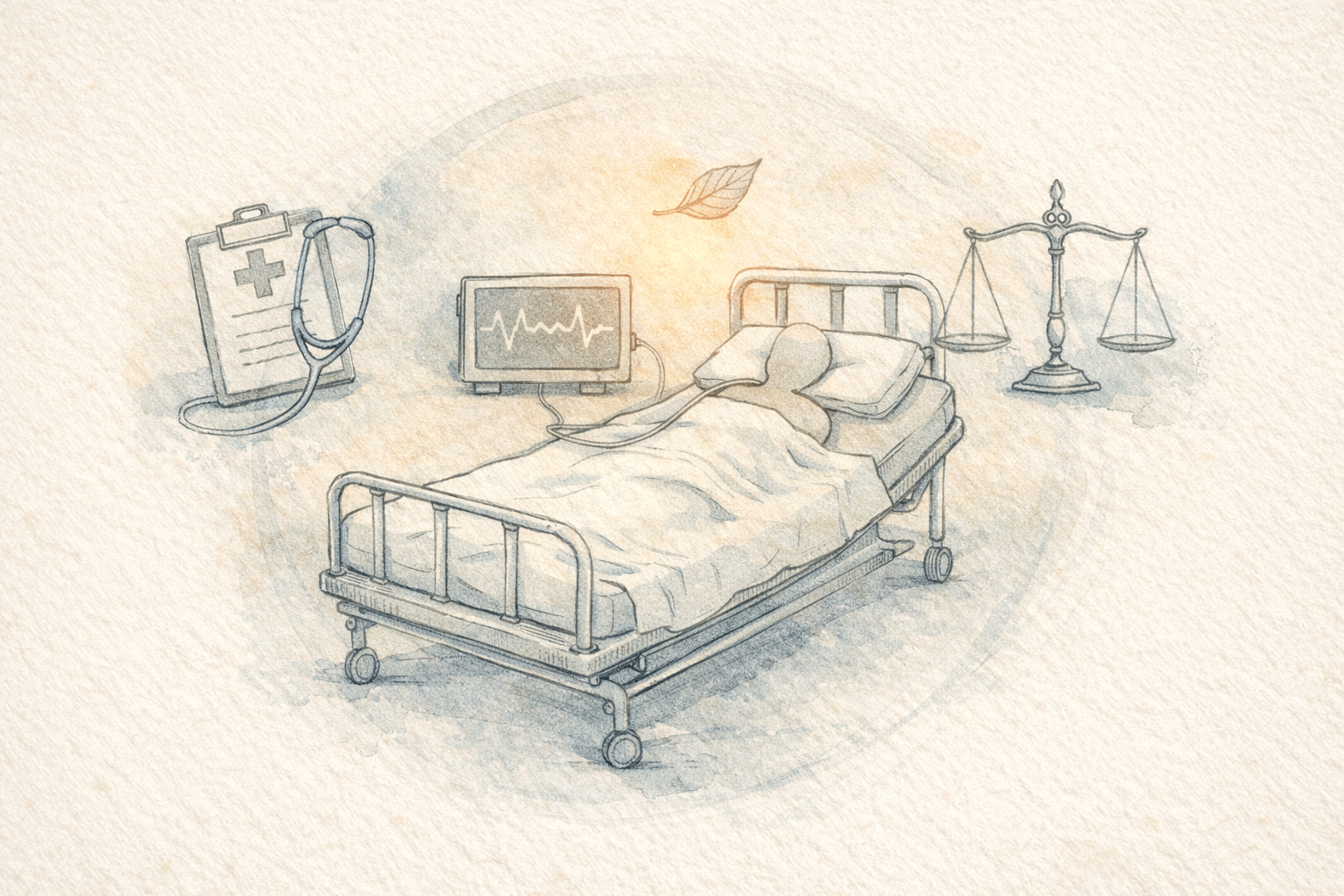
The Euthanasia Law in India
Euthanasia is of two types:
i) Active Euthanasia: where a lethal chemical is injected into the body to terminate the life
ii) Passive Euthanasia: where the life support systems are disconnected to allow the termination to occur.
Passive euthanasia is further classified as voluntary and non-voluntary.
Voluntary passive euthanasia involves a terminally ill patient making a conscious, competent, mentally stable informed decision to die when medical treatments merely prolong the quantity of life and not the quality. Such advance directives are written wills or documents expressly put in place by the patient.
Non voluntary passive euthanasia refers to patients who are in permanent vegetative state, an irreversible coma, mentally unstable patients who are not conscious or competent to make an informed decision themselves.
There was no legal sanction whatsoever in India for any type of euthanasia. That changed in 2011 when the SC in Aruna Ramchandra Shanbaug v. Union of India is (2011) 4 SCC 454 first recognised the legality of (only) passive euthanasia. Active euthanasia is not recognized and illegal in India.
In 2018, SC declared that the ‘right to die with dignity’ is as much a fundamental right under Article 21 as is the right to life. The SC also laid down ‘guidelines’ for execution of euthanasia that had inbuilt safeguards against misuse. These guidelines were modified in 2023, further strengthening the procedures to ensure that euthanasia is applied strictly in the best interests of the suffering person. In March 2026, Supreme Court allowed passive euthanasia following its own prescribed guidelines.

The Apex Court has laid down strict procedure / guidelines for passive euthanasia in the country:
Advanced Medical Directive or ‘Living Will’: This is a written document, like a Will of property, made by a person while his brain is functioning normally, in which he stipulates the nature and extent of medical treatment to be given to him in the event of his being unable to make this decision himself as a consequence of his going into a ‘coma’ or ‘vegetative state’ or ‘brain dead’ condition. In this document he can also name and authorise the person(s) who can make such decisions on his behalf. Courts shall recognise the legal validity of this document that is signed by two witnesses and duly attested by a Notary Public or Gazetted Officer and maintain its soft/hard copies. The local municipal body shall also maintain a copy of the same.
Primary Medical Board: This is a team of medical doctors to be constituted by the physician under whose treatment in a hospital the person has been when the ‘euthanasia’ situation arises. This Board shall be constituted by the treating physician only after (i) the Advance Directive is verified by him for genuineness and (ii) all treatment options have been exhausted and he is convinced that the person’s medical condition is indeed ‘incurable’. The Board shall comprise minimum two specialists in relevant fields (neurology, oncology, general medicine, etc) each having minimum five years’ experience, in addition to the treating physician. This Board will give its opinion on whether the need has arisen for the instructions in the Directive to be implemented. The Board’s opinion shall then be submitted to the District Collector.
Secondary Medical Board: This is another team of medical doctors constituted by District Collector on his receipt of Primary Board’s opinion recommending euthanasia. This Board will be headed by the District Medical Officer and comprise minimum two relevant specialists with minimum five years’ experience. This Board will re-examine the person to either validate or reject the Primary Board’s opinion.
Time Limit for the two Boards: In the guidelines of 2018, there was no time limit prescribed for the Boards, thus prolonging the person’s agony indefinitely. In the modified guidelines of 2023, a time limit of 48 hours has been stipulated for both Primary and Secondary Boards to arrive at their opinions. In case the Secondary Board rejects euthanasia, the person authorised in the Advanced Directive has the option of appealing to High Court for constitution of a fresh medical Board for re-evaluation.
The verdict in Harish Rana case has been welcomed by the patient’s family, legal luminaries and the public at large. Yet there is general sense of cautious optimism as euthanasia law could be a double-edged sword – intended for human good but capable of misuse or delay in implementation.
An objective look at various aspects of euthanasia for better understanding of this sensitive socio-legal issue.
Human(e) objective
DIGNITY IN DEATH (AS IN LIFE)
Human race thrives on physiological needs (food and shelter ) and psychological/ emotional needs -freedom of thought, word and deed, independence of existence, self-respect and prestige which are equally essential to live life with ‘dignity’. When a person goes into a comatose or vegetative state and despite all efforts, his medical condition is proven to be incurable, that person becomes a physically, financially and emotionally dependent on his near and dear ones. Keeping such a person clinically alive serves no practical purpose other than destroying his dignity. In such a situation, euthanasia or ‘mercy killing’ allows the person to ‘die with dignity’.
AUTONOMY & INDEPENDENCE
Euthanasia upholds the independence and autonomy of a person whose right, to decide how his body is to be treated in the event of an incurable medical condition, is implicitly guaranteed by Article 21 as has been decreed recently by Supreme Court.
FAMILY WELL-BEING
Euthanasia protects the affected person’s family from financial and emotional strain that can result from indefinite medical treatment.
CONSERVATION / DONATION OF VITAL RESOURCES
Euthanasia prevents avoidable wastage of material and professional resources on the affected person once his condition is proven to be incurable. Not only the resources of the family can be conserved for his dependent family, but the patients valuable vital organs can be donated to others in need thus saving other lives.
Pitfalls
LEGAL DELAYS & MISINTERPRETATION
Time is of essence in such legal procedures. Though the 2023 SC guidelines streamlined the procedures and laid down time-lines, substantial time is consumed in deciding on the merits of each case. This only prolongs the agony of the patient.
MEDICAL ERROR IN DIAGNOSIS
Medical professionals and experts may be prone to error while arriving at their decision on implementing euthanasia. Even though the diagnosis is done by two separate Boards, primary and secondary, the scope for error cannot be summarily ruled out. In such a case, a human life would have been extinguished wrongfully, in violation of Article 21 however unintentional it may be.
Medical professionals often hesitate to undertake non voluntary euthanasia for fear of retribution, professional misconduct and legal liability.
‘End of life’ care or palliative care is not a facility accessible, available or affordable to all. There is urgent need for a framework to govern such medical treatment.
RELIGIOUS AND MORAL SANCTITY OF HUMAN LIFE
All religions consider human life to be sacrosanct. It is believed that it is the creator of the universe who gives life and hence only He can take away life. From the moral angle, euthanasia is an affront to this belief as it causes moral degradation of life.
POTENTIAL FOR ABUSE
While Voluntary passive euthanasia is easy to govern since it involves the patient themselves to give an advance directive, non-voluntary passive euthanasia is a grey area as the patient is absolutely incompetent / incapable of making an informed decision. Since they cannot decide for themselves, their family or medical professionals must make the decision. This could pave the way for misuse of the legal provision due to materialistic greed or sheer weariness of patient care. There is no denying the fact that in spite of all safeguards and procedures built into the guidelines there is a chance of Euthanasia being misused by some people, for reasons of profit or passion. It is in human nature to subvert any system, societal or legal, for unscrupulous ends
Euthanasia is a slippery path to embark upon.
It is a curious intermingling of morality, autonomy legality and individual will to live or die.