
Insights
SEBI (LODR) (Amendment) Regulations, 2026
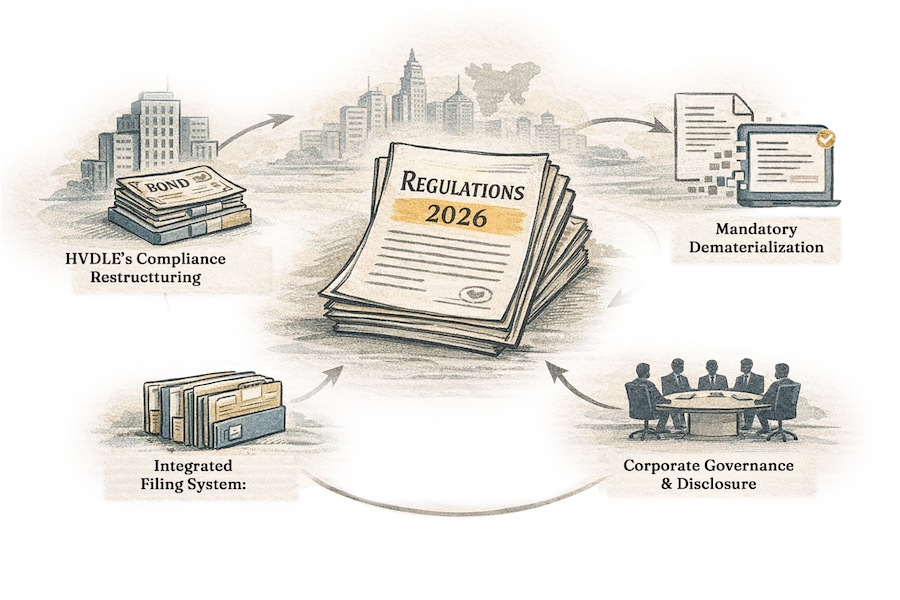
The Securities and Exchange Board of India (SEBI) notified the SEBI (Listing Obligations and Disclosure Requirements) (Amendment) Regulations, 2026, which were published in the Official Gazette on January 20, 2026, and came into force with immediate effect. These amendments introduce targeted changes to the LODR framework, focusing on three main areas: restructuring the compliance framework for High Value Debt Listed Entities (HVDLEs), strengthening investor services through mandatory dematerialization, and refining corporate governance and disclosure norms.
1.
Restructuring the High Value Debt Listed Entity (HVDLE) Framework
The most significant change is the revision of the threshold for identifying HVDLEs. The outstanding value of listed non-convertible debt securities required for classification as an HVDLE has been increased from Rs. 1,000 crore to Rs. 5,000 crore. This change, which was proposed by SEBI in October 2025, provides immediate compliance relief for mid-sized bond issuers, including many Non-Banking Financial Companies (NBFCs), and encourages them to raise funds through corporate bond issuances without the burden of stringent governance norms.
The provisions of Chapter VA will continue to apply until the outstanding debt remains below the new threshold for three consecutive financial years. For entities that continue to qualify as HVDLEs, governance norms have been significantly aligned with those for equity-listed entities.
Key changes include:-
- Director Age Cap: HVDLEs must ensure compliance with the age cap for non-executive directors (attaining 75 years) at the time of appointment or re-appointment. A special resolution is required to appoint or continue a director who has reached this age .
- Related Party Transactions (RPTs): HVDLEs are now required to comply with most provisions of Regulation 23, bringing debt market governance closer to equity-style discipline. Certain exemptions apply, such as for transactions between public sector companies and for payments of statutory dues .
- Key Managerial Personnel (KMPs) and Board Committees: Vacancies in the office of KMPs must be filled within three months. For companies emerging from a Corporate Insolvency Resolution Process (CIRP), this timeline starts from the date of approval of the resolution plan . Vacancies in board committees must also be filled within three months.
- Secretarial Audit: HVDLEs are now mandated to appoint a secretarial auditor as per Regulation 24A, starting from the financial year 2026-27.
2.
Strengthening Investor Services and Dematerialization
The amendments introduce key changes to modernize and secure the process of handling securities, reinforcing the shift towards a complete dematerialized regime.
- Mandatory Demat Credit: Regulation 39(2) has been substituted to mandate that the credit of securities pursuant to investor service requests (such as subdivision, consolidation, renewal, exchange, or issuance of duplicate certificates) must be effected only in dematerialized form and within a period of thirty days from the date of receipt of the request. This effectively abolishes the “Letter of Confirmation” (LOC) mechanism.
- Prohibition on Physical Transfer Requests: Regulation 40 has been amended to explicitly prohibit listed entities from processing any transfer requests unless the securities are held in dematerialized form . However, a critical exemption has been provided for transfers of securities where the transfer deed was executed before April 1, 2019, and the securities are still held in physical form. These may continue to be registered, subject to conditions specified by SEBI. A special one-year window for this purpose has been opened from February 5, 2026, to February 4, 2027.
Electronic Payment Mandate: Aligning with a digital push, the amendments require listed entities to use RBI-approved electronic modes for all payments related to dividends, interest, or redemption/repayment amounts, removing the earlier option of issuing physical cheques or warrants.
3.
Related Party Transactions (RPTs)
Beyond the application to HVDLEs, the amendments introduced in late 2025, which are part of this broader update, rationalized the materiality thresholds for RPTs requiring shareholder approval . The fixed cap of Rs. 1,000 crore has been replaced with a graded scale based on the listed entity’s consolidated turnover, as detailed in the new Schedule XII. For entities with a turnover above Rs. 20,000 crore, the threshold is capped at Rs. 5,000 crore. Furthermore, for RPTs involving a subsidiary, a new absolute floor of Rs. 1 crore has been introduced. Audit committee approval is now required only for transactions above this amount. The exemption for retail purchases has also been expanded to include relatives of directors and Key Managerial Personnel (KMPs) .
4.
Other Key Updates
- Integrated Filing System: The Master Circular consolidates reporting into two main streams: Integrated Filing (Governance) and Integrated Filing (Financial), streamlining submissions to stock exchanges.
- Corporate Governance Report: SEBI has clarified through informal guidance that the quarterly compliance report on Corporate Governance must be placed before the full Board of Directors. Review by a committee, even if permitted under other sectoral regulations like RBI norms, does not fulfill this requirement.
- Annual Report Disclosures: The scope of disclosures in the annual report has been broadened to include requirements under the specific statute under which a listed entity (e.g., statutory corporations like LIC or SBI) is constituted . Timelines for submission have also been aligned with the date of submission to the government.
In conclusion,
the January 2026 amendments to the SEBI LODR Regulations adopt a balanced approach by rationalizing the compliance burden for mid-tier debt issuers while simultaneously tightening governance norms for larger entities and accelerating the complete digitization of securities handling and investor services.