
in focus
RBI’s Role in FinTech Regulation
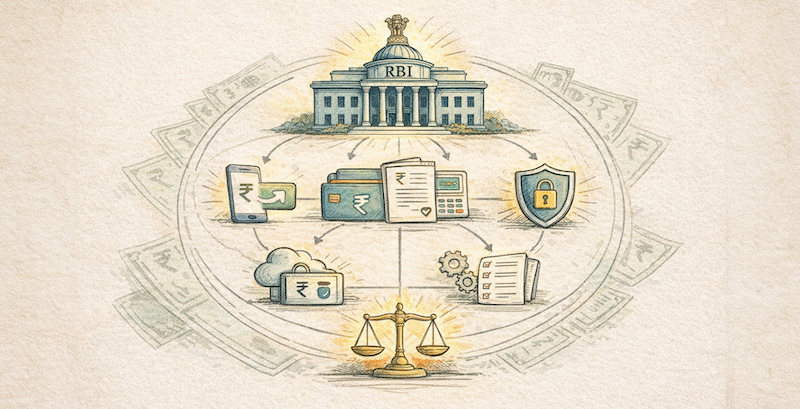
The RBI plays a central role in regulating payment systems, digital lending, and various forms of financial intermediation enabled through technology. Several regulatory frameworks issued by the RBI have significantly shaped the FinTech ecosystem.
One of the key regulatory frameworks relates to Payment Aggregators and Payment Gateways. Payment aggregators are entities that facilitate online payments by merchants without the need for them to create separate payment integrations with banks. Such entities are required to obtain authorization from the RBI, comply with capital requirements, implement escrow mechanisms, and ensure strict security and data protection standards.
In addition, the RBI has also issued Digital Lending Guidelines to regulate lending activities carried out through mobile applications and digital platforms. These guidelines aim to address concerns around predatory lending practices, opaque fee structures, and misuse of borrower data. Under these rules, lending must be undertaken either by regulated entities or in partnership with regulated lenders, and loan disbursements and repayments must occur directly between the lender and the borrower’s bank accounts.
The RBI has also established Regulatory Sandboxes, allowing FinTech innovators to test new products and services in a controlled regulatory environment before full-scale deployment. This initiative reflects the regulator’s attempt to balance innovation with consumer protection.
KYC and Customer Due Diligence Requirements
Know Your Customer (KYC) norms form the backbone of financial compliance in India. These requirements aim to prevent money laundering, identity theft, financial fraud, and the misuse of financial platforms for unlawful activities.
FinTech companies that facilitate financial transactions or onboarding of customers must adhere to KYC norms prescribed under the Prevention of Money Laundering Act (PMLA) and the RBI’s KYC Master Directions.
The process generally involves verifying a customer’s identity and address through officially valid documents such as Aadhaar, passport, or voter identification. Over the years, India has also introduced digital KYC mechanisms, including Aadhaar-based authentication, video-based customer identification processes (V-CIP), and offline Aadhaar verification.
Digital KYC has significantly streamlined customer onboarding for FinTech platforms, enabling faster verification while maintaining regulatory compliance. However, companies must ensure that such processes are conducted through secure systems and in accordance with the privacy and security safeguards prescribed by regulators.
Regulation of Digital Payments
India’s digital payments infrastructure has expanded dramatically, largely driven by the widespread adoption of platforms such as Unified Payments Interface (UPI), mobile wallets, and payment gateways.
The RBI regulates payment systems under the Payment and Settlement Systems Act, 2007, which governs entities involved in facilitating electronic payments. Payment service providers must comply with operational standards, settlement procedures, and security protocols mandated by the RBI.
In recent years, regulators have also emphasized data localization and payment security. Payment system operators are required to store payment data within India, ensuring that transaction-related information remains accessible to regulatory authorities for supervisory purposes.
Additionally, strict guidelines exist around merchant onboarding, fraud monitoring, transaction authentication, and grievance redress mechanisms. FinTech companies must maintain robust internal compliance frameworks to manage these obligations.
Data Protection and Consumer Trust
While financial regulation forms the primary compliance framework for FinTech companies, data protection is increasingly becoming a central concern. FinTech platforms routinely process large volumes of personal and financial data, making them high-value targets for cyber threats.
India’s evolving data protection regime places obligations on organizations to ensure lawful processing of personal data, implement adequate security safeguards, and maintain transparency in their data practices. For FinTech companies, compliance with data protection standards is closely tied to maintaining customer trust and avoiding regulatory scrutiny.
Compliance as a Strategic Imperative
Regulatory compliance in the FinTech sector should not be viewed merely as a legal obligation. In a highly competitive ecosystem, strong compliance frameworks can become a strategic advantage. Investors, regulators, and customers increasingly favour companies that demonstrate responsible data practices, transparent lending models, and strong governance standards.
FinTech companies must therefore adopt a proactive compliance approach, involving legal audits, regulatory mapping of their business models, and continuous monitoring of evolving regulatory developments.
Conclusion
India’s FinTech sector continues to expand at an unprecedented pace, driven by technological innovation and a growing digital economy. However, this growth is accompanied by an evolving regulatory environment aimed at safeguarding consumers, maintaining financial stability, and preventing misuse of financial platforms.
For FinTech companies, navigating RBI compliance, adhering to KYC norms, and understanding digital payment regulations are fundamental to sustainable operations. Companies that successfully integrate compliance into their operational and technological frameworks will be better positioned to scale, attract investment, and build long-term credibility within India’s rapidly evolving financial ecosystem.