
IPR
The Nuclear Patent Revolution:
Analysis of the SHANTI Act, 2025
The Sustainable Harnessing and Advancement of Nuclear Energy for Transforming India Act, 2025, known as the SHANTI Act, was published in the Official Gazette on December 21, 2025, bringing into force landmark amendments to India’s patent regime for nuclear energy inventions.
This legislation represents a fundamental paradigm shift in how India approaches intellectual property rights in the nuclear sector, moving from a six-decade-old absolute prohibition to a nuanced conditional permission framework.
The Historical Barrier to Nuclear Innovation
Prior to the SHANTI Act, India maintained one of the world’s most restrictive patent regimes for nuclear technology. Section 4 of the Patents Act, 1970 operated as an absolute bar, stating that no patent shall be granted in respect of an invention relating to atomic energy falling within sub-section (1) of section 20 of the Atomic Energy Act, 1962. Section 20(1) of the Atomic Energy Act, 1962 cast an extraordinarily wide net, covering virtually any invention related to the production, control, use, disposal, prospecting, mining, extraction, enrichment, or utilization of prescribed substances. This created what experts have termed a blunt instrument, as if an invention touched atomic energy in any manner, whether a nuclear weapon component or a hospital imaging device, it was automatically deemed non-patentable.
The practical consequence of this framework was severe, as private sector innovation was effectively stifled. Companies and research institutions were unwilling to invest in nuclear research and development when patent protection was statutorily unavailable, leaving India’s innovation ecosystem in critical areas like nuclear medicine, food irradiation, and industrial safety systems underdeveloped and reliant almost entirely on government-funded research.
The Legislative Transformation
The SHANTI Act, which received the President’s assent on December 20, 2025, fundamentally restructured this framework by repealing and replacing both the Atomic Energy Act, 1962 and the Civil Liability for Nuclear Damage Act, 2010, with the core objective of enabling private sector participation in nuclear innovation.
The blanket prohibition contained in Section 4 of the Patents Act has now been replaced with a conditional permission framework under which patents may be granted for inventions relating to the peaceful uses of nuclear energy and radiation.
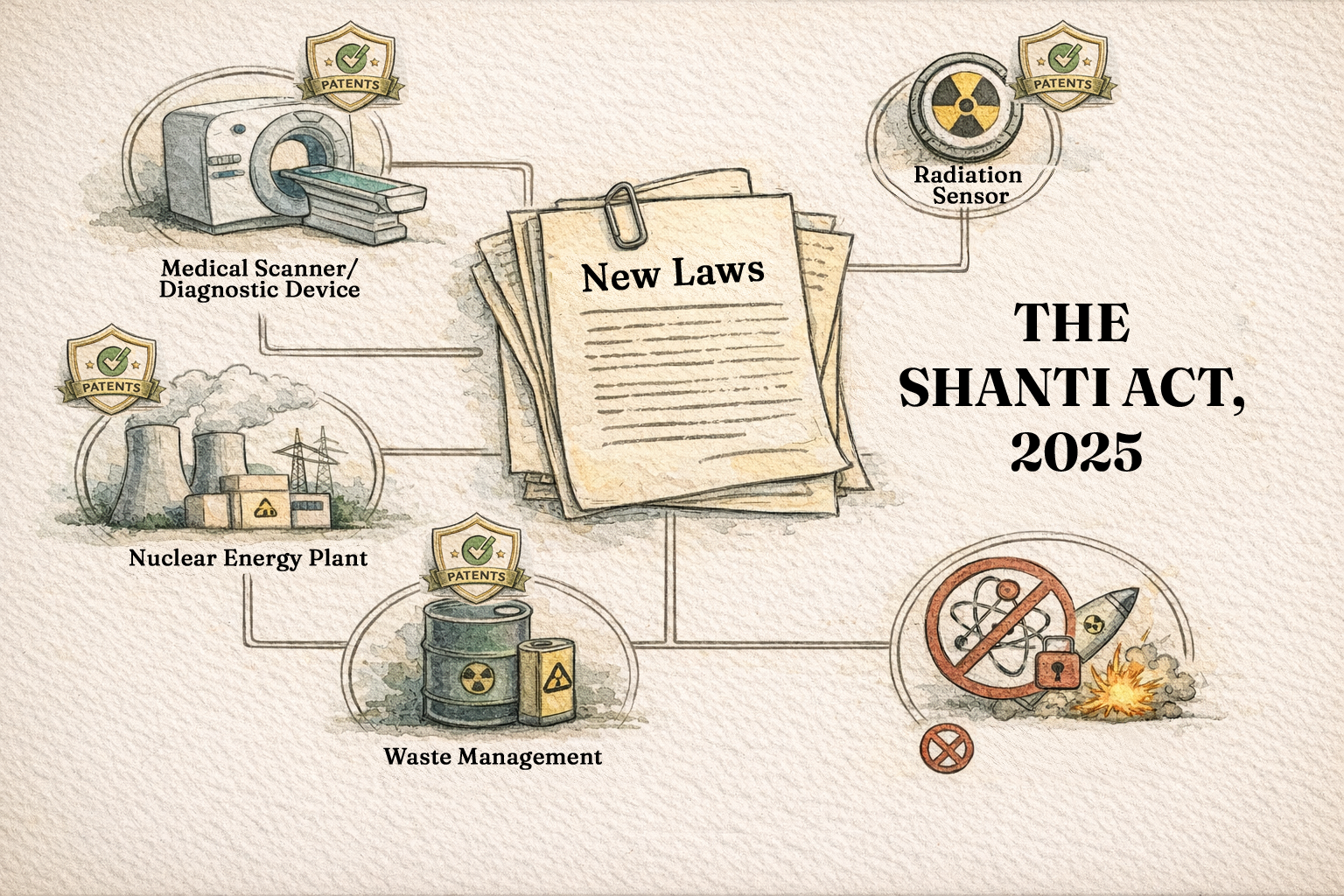
The amendment draws a clear distinction between permitted inventions, which include those serving civilian, commercial, medical, or industrial purposes such as medical diagnostic devices, radiation safety sensors, nuclear waste management technologies, and clean energy generation systems, and excluded inventions, which are those deemed sensitive or having national security implications.
New Procedural Requirements for Patent Applicants
The Act introduces two critical procedural requirements that applicants must navigate. First, inventions determined to have national security implications are deemed automatically owned by the Central Government, a provision that ensures genuinely sensitive technologies remain under state control while permitting private patent protection for non-sensitive civilian applications. Second, patent applicants must now communicate any nuclear-related invention to the government before disclosing to third parties, creating a pre-grant scrutiny mechanism that allows the government to assess whether an invention falls within the sensitive category before any public disclosure or commercialization occurs.
Strategic Considerations for Innovators
For companies, research institutions, and start-ups, the SHANTI Act fundamentally changes the calculus for nuclear-related innovation and introduces several strategic considerations that must be carefully addressed. Applicants must conduct an internal assessment of whether their invention serves peaceful purposes or may be deemed sensitive, and this assessment should be documented and supported by technical justification. Prior to any public disclosure, including academic publications, conference presentations, or third-party discussions, the invention must be communicated to the Central Government with a clear articulation of its civilian application and peaceful purpose. Patent specifications should explicitly delineate the peaceful applications of the invention, distinguishing it from potential sensitive uses, and claims should be directed to commercial, medical, or industrial embodiments.
During examination, applicants should be prepared to demonstrate that their invention falls within the permitted category, with technical evidence, comparative analysis, and expert affidavits potentially necessary where borderline issues arise. Despite the liberalization, uncertainties remain as the Act does not define sensitive or national security implications with precision, leaving interpretive discretion with the government and creating potential for divergent assessments across different technologies or examining officers.
Alignment with Global Practices
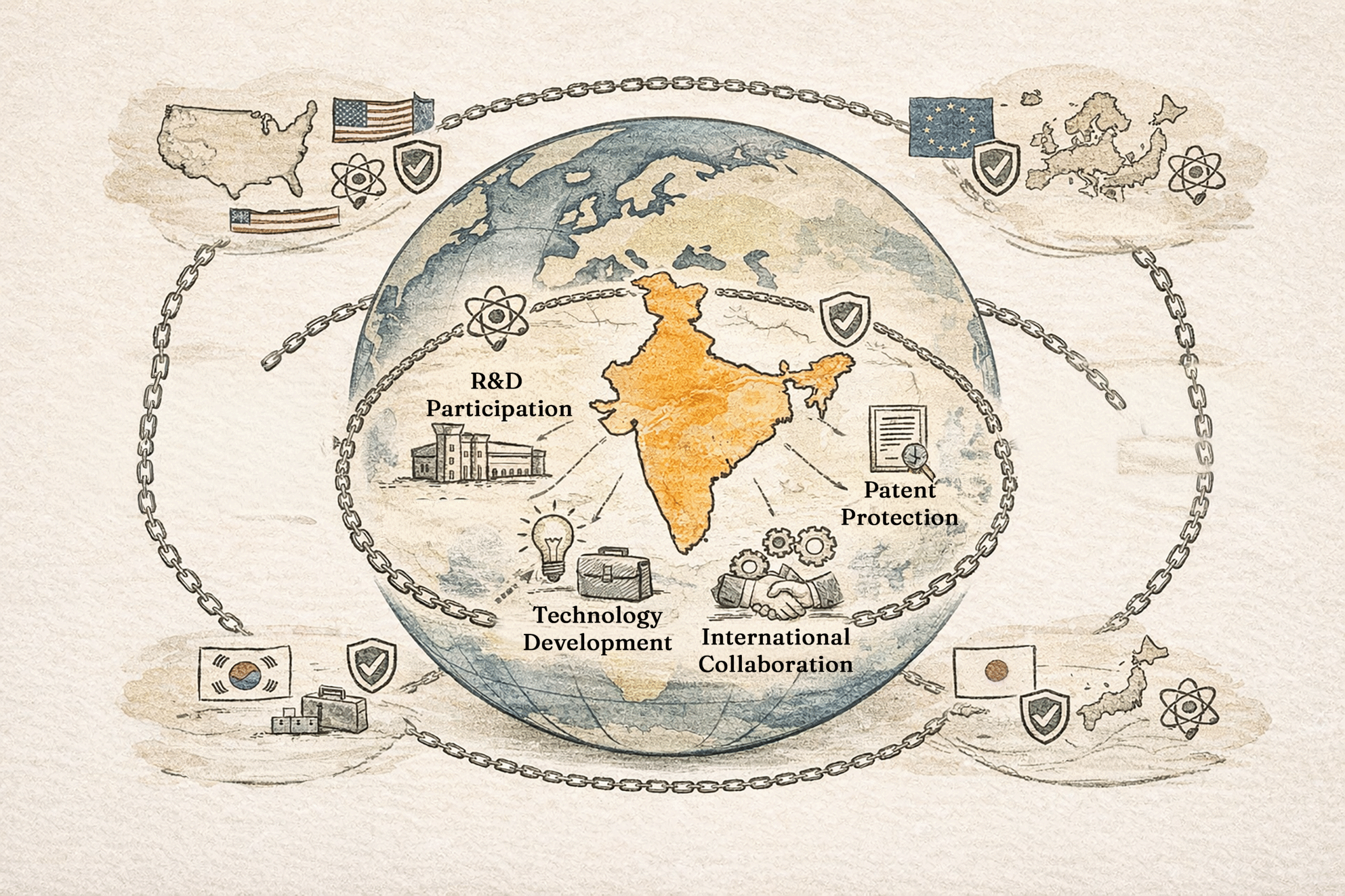
The SHANTI Act brings India into alignment with major innovation economies including the United States, European Union, Japan, and South Korea, all of which permit patents for civilian nuclear applications while maintaining security restrictions for sensitive technologies. This harmonization is critical for international collaboration, technology transfer, and foreign investment in India’s nuclear sector. For the first time, Indian private companies, start-ups, and research institutions can invest in nuclear research and development with confidence that patent protection is available, commercialize civilian nuclear technologies through licensing and assignment, participate in global nuclear supply chains, attract venture capital and private equity funding for nuclear innovation, and collaborate with international partners on joint research initiatives.
Sectoral Impact and Future Outlook
The impact across specific sectors is profound, as medical device companies can now patent radiation-based diagnostic and therapeutic equipment, fostering domestic manufacturing and reducing import dependence, while clean energy start-ups can protect innovations in small modular reactors, safety systems, and efficiency improvements. Sensors, monitoring systems, and safety equipment for nuclear facilities become patentable, encouraging innovation in workplace and environmental safety, and technologies for nuclear waste processing, storage, and disposal can now be patented, addressing one of the industry’s most pressing challenges.
The SHANTI Act represents a watershed moment in Indian patent law, as by dismantling the six-decade-old absolute prohibition on nuclear patents and replacing it with a nuanced conditional framework, India has signaled its commitment to fostering innovation while safeguarding national security. The amendment transforms nuclear energy from a state-monopoly domain to a collaborative ecosystem involving private enterprise, research institutions, and international partners, and for patent practitioners and innovators, it opens an entirely new frontier of patentable subject matter with significant commercial and strategic potential that will unfold in the years to come as the practical implementation of this framework takes shape.