
Arbitration
Section 34 of A&C Limitation Runs From Section 33 Disposal, Rules Supreme Court
Excerpt
The Supreme Court has held that limitation for challenging an arbitral award under Section 34(3) of the Arbitration Act runs from the date a Section 33 correction application is disposed of, not from the original award date. This applies regardless of whether the Section 33 application ultimately succeeds, provided it was genuinely and formally invoked before the tribunal and not filed merely to defeat limitation.
NHAI’s Land Acquisition Battle Turns on a Limitation Technicality
In a ruling with significant implications for arbitration practice, the Supreme Court has clarified when the clock starts ticking on a party’s right to challenge an arbitral award. The decision, delivered by a bench of Justices Pamidighantam Sri Narasimha and Alok Aradhe, arose from a long-running land acquisition dispute between the National Highways Authority of India (NHAI) and a landowner in Karnataka’s Bellary district.

Background of the Dispute
The land in question was acquired in 2009-2010 under the National Highways Act, 1956, for road development. After the competent authority fixed compensation, NHAI invoked arbitration. Following a first arbitral award, a round of litigation, and a remand, the arbitrator passed a fresh award in February 2022, granting the landowner enhanced compensation along with statutory benefits under the Land Acquisition Act, 1894.
Both sides were dissatisfied. NHAI filed an application under Section 33(1)(a) of the Arbitration and Conciliation Act, 1996, seeking correction of the award, arguing the enhanced benefits were not legally sustainable. The landowner filed his own Section 33 application, seeking an additional 50% market-value uplift he claimed had been omitted from the award. The arbitrator dismissed both applications in July 2022.
NHAI then filed its objections under Section 34 of the Act — the provision that allows a court to set aside an arbitral award — in October 2022, along with an application to condone delay. The landowner objected, contending the Section 34 challenge was time-barred, since it came more than 120 days (the maximum condonable period) after the original award.
The Legal Question
The trial court condoned the delay, but the Karnataka High Court reversed that finding. It held that NHAI’s Section 33 application was not a genuine request for correction of clerical or computational errors, but an attempt to seek substantive modification of the award — something outside the narrow scope of Section 33. Since the application did not properly fall within Section 33, the High Court reasoned, it could not extend the limitation period, and the subsequent Section 34 challenge was therefore filed too late.
This set up the central question before the Supreme Court: does the three-month limitation period under Section 34(3) run from the date of the original award, or from the date a Section 33 application — even one that is later dismissed — is disposed of by the tribunal?
The Court's Reasoning
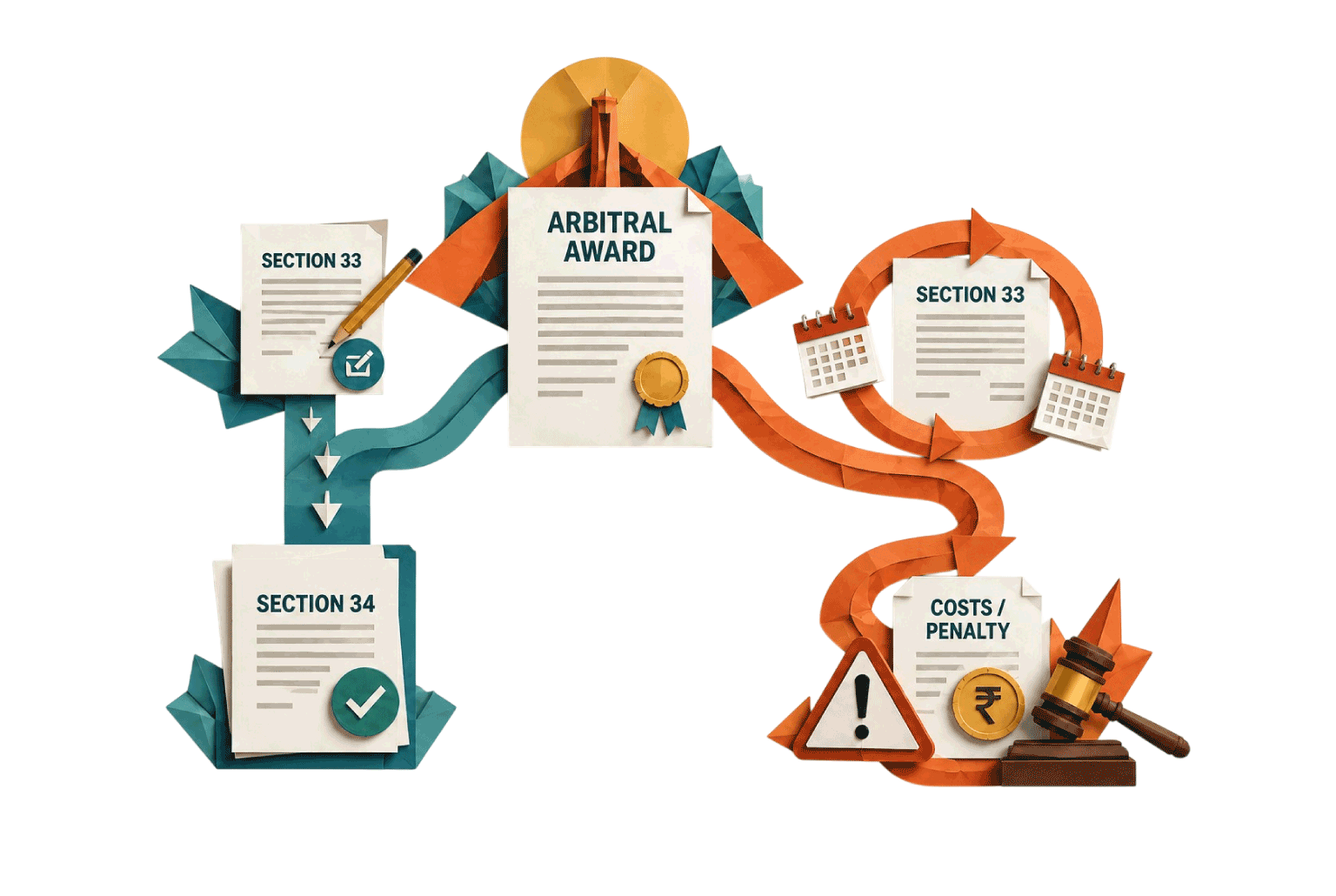
The Supreme Court sided with NHAI. It held that Section 34(3) draws no distinction between Section 33 applications that succeed and those that fail. Where a party has formally invoked the tribunal’s jurisdiction under Section 33 and the tribunal has entertained the request, the limitation period for a Section 34 challenge begins only when that request is disposed of — irrespective of the outcome.
The Court reasoned that requiring parties to file Section 34 challenges “as a matter of abundant caution” while a Section 33 application remains pending would create procedural uncertainty and multiply proceedings unnecessarily. It distinguished the precedent relied upon by the landowner, State of Arunachal Pradesh v. Damani Construction Co., noting that the case involved a mere letter seeking clarification, not a formal application invoking Section 33 — a materially different situation from the one before it.
The bench also relied on its recent decision in Geojit Financial Services Ltd. v. Sandeep Gurav (2025), reaffirming that the operative date for limitation purposes is the date of disposal of the Section 33 request, not the date of the award itself.
A Caveat Against Abuse
While ruling in NHAI’s favour, the Court was careful to guard against misuse of the principle. It clarified that where Section 33 applications are found to be sham, frivolous, or filed in bad faith solely to buy extra time, courts remain free to impose exemplary and punitive costs. The ruling thus draws a line between legitimate recourse to Section 33 and its use as a tactical device to defeat limitation.
Outcome
Applying this reasoning to the facts, the Court found that NHAI received the order disposing of the Section 33 applications on 15 September 2022 and filed its Section 34 applications on 7 November 2022 — comfortably within the statutory period. The High Court’s judgment was set aside, the trial court’s order condoning delay was restored, and the Section 34 applications were sent back to be decided on their merits.
The judgment offers welcome clarity for arbitration practitioners: a formally invoked Section 33 application, whatever its eventual fate, resets the limitation clock for a Section 34 challenge — provided it is not a colourable device to gain time.
(Case: National Highway Authority of India v. T. Younis & Anr., 2026 INSC 616)