
clause & effect
The Public Examinations (Prevention Of Unfair Means) Amendment Act, 2026 [Act No. 10 of 2026]
The NEET medical entrance exam paper leak in May’26 and consequent social and political turmoil led the central government to initiate comprehensive reforms in the examinations system.
A strategic part of this initiative is the introduction of The Public Examinations (Prevention of Unfair Means) Amendment Bill, 2026 [Amendment] in the Parliament on 27th July’26. The Bill was passed on 30th July’26.
The second part is the constitution of ‘NTA Exam Reforms Task Force’, a high-powered committee of experts headed by renowned technologist Nandan Nilakeni, to formulate structural, institutional and technological changes in not only the National Testing Agency [NTA] that conducts NEET exams but also in other public services recruitment bodies and agencies.

Highlights of the amendments made in the original The Public Examinations (Prevention of Unfair Means) Act of 2024 [Act], that have been overdue and welcomed, can broadly be categorised as follows:
(A)
More stringent punishment for offenders:
SL NO. | OFFENCE COMMITTED BY | PRISON TERM [YEARS] | PENALTY [RUPEES] | ||
ACT | AMENDMENT | ACT | AMENDMENT | ||
1 | Individual Person(s) | 3 to 5 | 5 to 10 | up to 10 lakhs | up to 50 lakhs |
2 | Service Provider | 4 (debarment) | 8 (debarment) | up to 1 crore | up to 5 crores |
3 | Service Provider’s Person-in-Charge | 3 to 10 | 5 to 10 | 1 crore | 5 crores |
4 | Organised Crime (group of persons) | 5 to 10 | 7 to 10 | 1 crore | 10 crores |
It is to be noted that punishment in terms of prison term/debarment and penalty provided in the Amendment is more stringent in quantum, hence will prove to be more dissuasive in nature for offenders.
(B)
Special Task Force for a time bound investigation of all exams related offenses:
- In addition to the State police and central agencies like CBI, NIA, etc., the central government is empowered to constitute a ‘Special Task Force’ [STF] for investigating offences under this Act.
- When constituted, the STF alone shall investigate offences under this Act.
- STF shall conclude investigation within a period of two (2) months commencing from date on which government notifies constitution of STF.
The objective of constituting STF is to ensure that (i) there is no scope for delay in investigation beyond the 2 month period, unlike in Lok Pal Act, Lok Ayukta Act and SC&ST Acts where reasons for delay in investigation are to be provided for extending the period.
Practically though it is very difficult for investigation to be concluded within 2 months, considering the complexities involved in coordination between state and central agencies.
(C)
Expeditious disposal of cases in Special Fast Track Courts, within a defined timeline:
- All States and Union Territories, in consultation with their High Courts, shall constitute a Special Fast Track Court [SFTC] exclusively for offences under this Act.
- Trials, to be conducted by SFTC on a daily basis, shall be completed within a period of three (3) months starting from the date of filing of chargesheet.
- Offences of the accused under this Act that are already under trial in other courts under other Acts/laws shall be transferred to SFTC, to be simultaneously tried within 3 months from date of such transfer.
- Appeal on SFTC order can be made to a 2-judge bench of High Court within 30 days of the order. Even in cases where HC accepts reasons for delays, 90 days from date of order is final deadline for appeal.
- HC shall dispose of such appeals within three (3) months, as far as possible.
The procedure of a specific executive order for creating SFTC for each individual offence is done away with by means of this Amendment. To that extent the amendments is a welcome step.
However, its implementation is bound to face many challenges-
- A fundamental legal issue exists in fixing time frame for concluding trials: Supreme Court has held that it is neither feasible nor permissible to prescribe time limit for trial; nor is it proper for a court to stop its proceedings merely due to lapse of time
- There are other SFTCs already in existence for years for offences under POCSO Act. Statistical analyses of these courts are not encouraging at all.
- Inadequate number of judges, counsels, staff and infrastructure is a major reason for delays in concluding SFTC trials.
- Co-ordination between various state and central investigative agencies is another major bottleneck for speedy conclusion of trials.

In conclusion, the Amendment Bill 2024, which just become an Act, is a welcome step towards restoring public’s faith in our examinations system. However, it implementation could pose several challenges.
For full text of the Amended Act refer:
Statistics Relevant to Implementation of Amended Act
Cases pending in Special FastTrack Courts under POCSO Act, at the end of 2025
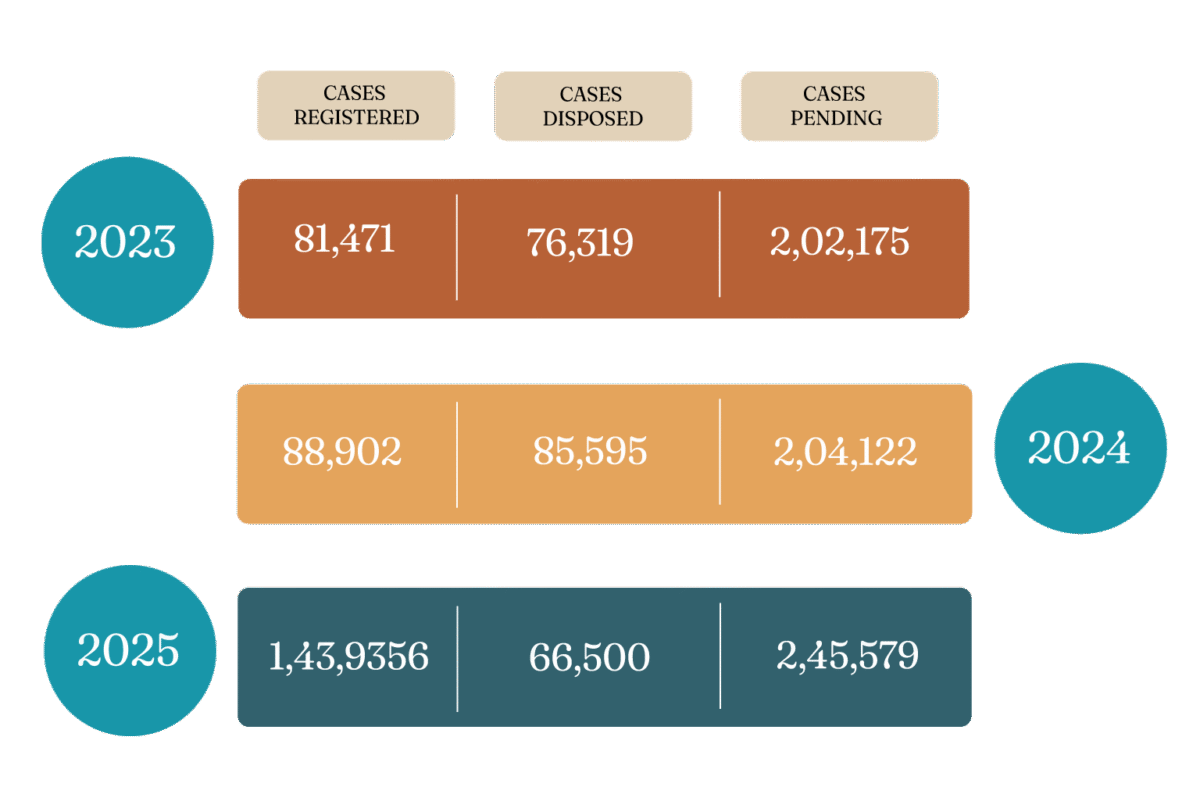
Source: Question No. 588, Rajya Sabha, Answer by Ministry of Law and Justice, 23rd July, 2026; PRS
Cases Pending Investigation, at the end of 2024
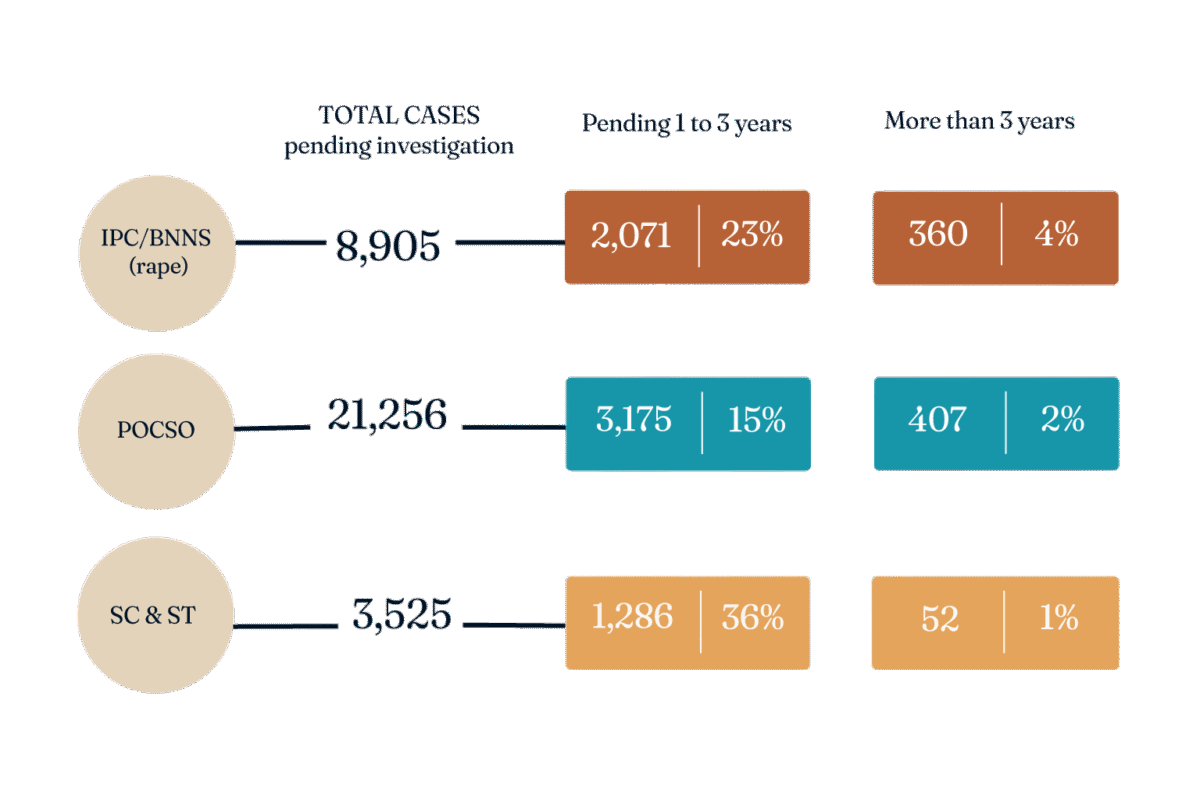
Source: National Crime Records Bureau’s Crime in India 2024 Report; PRS