
IPR
Delhi High Court Backs OpenAI on Fair Dealing in Landmark AI Training Case
Excerpt
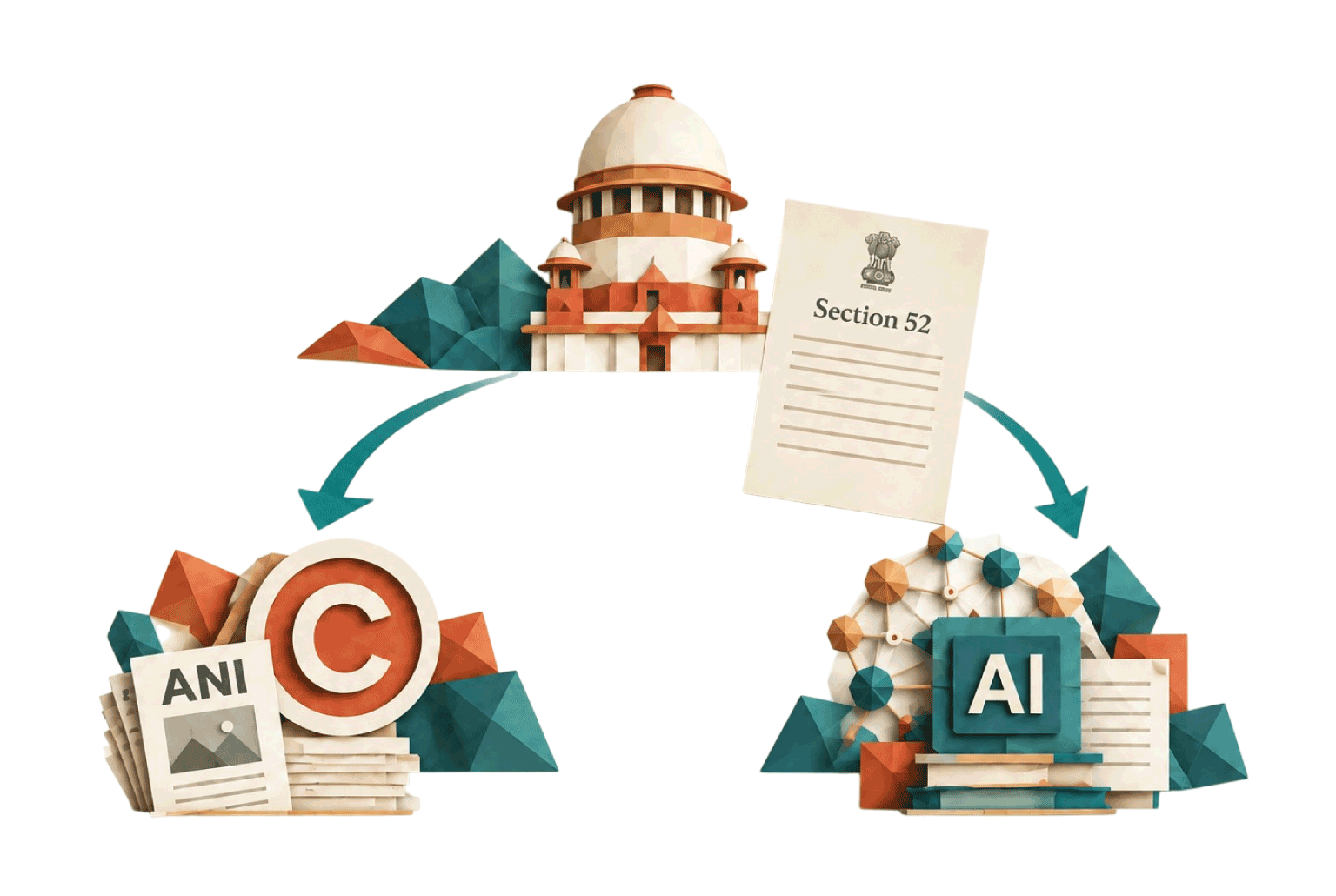
The Delhi High Court has refused ANI’s plea to injunct OpenAI, holding that training ChatGPT on its news content is prima facie fair dealing under Section 52 of the Copyrights Act, 1957. The ruling is interim, and the main suit, including a separate output-based claim, continues.

When News Training Met Copyright Law
For over a year, one lawsuit in the Delhi High Court has been watched more closely by AI companies and news publishers than perhaps any other case in the world outside the United States. On 24 July 2026, that case finally produced its first real answer, and it went in OpenAI’s favour.
How the Dispute Began
In November 2024, Asian News International (ANI), one of India’s largest news agencies, sued OpenAI, alleging that ChatGPT had been trained on its copyrighted news articles without authorisation. ANI’s case actually rested on two distinct claims. The first was a “training claim”, that OpenAI copied and stored ANI’s articles to train its large language models. The second was a “reproduction” or “output claim”, that ChatGPT, when queried, generated responses that reproduced ANI’s original reporting, and in some instances, attributed fabricated stories to the agency altogether. ANI argued that this combination amounted to both commercial exploitation of its work and reputational harm through AI-generated misinformation.
OpenAI’s defence centred on Section 52(1)(a)(i) of the Copyright Act, 1957, India’s fair dealing exception, which permits use of a work “for the purposes of private or personal use, including research,” without that use amounting to infringement.
The Question Before the Court
ANI sought an interim injunction to stop OpenAI from storing, reproducing, or otherwise using its content while the case proceeded to trial. To decide whether such an injunction was warranted, Justice Amit Bansal had to determine, at a preliminary, prima facie level only, whether ANI had a strong enough case of infringement to justify restraining OpenAI in the interim.
This required the court to answer a question India’s copyright statute was never written with in mind: does storing a news agency’s published articles inside a machine-learning training pipeline count as “private or personal use,” even when the resulting product, ChatGPT, is a commercial service used by millions of paying subscribers?
Two Tests, One Verdict
The court structured its analysis around two linked questions. The first was whether the storage of ANI’s works for training purposes fell within a permitted purpose under Section 52(1)(a) at all, the “purpose test.” The second was whether that use, even if for a permitted purpose, was actually fair in substance, the “fairness test.”
ANI urged a narrow reading, arguing that Indian law recognises a closed list of fair dealing purposes, unlike the open-ended “fair use” doctrine in the United States, and that reading large-scale commercial AI training into “private use” stretches the provision well past what Parliament intended. OpenAI, in turn, pushed for a broader interpretation, arguing that the internal storage and processing of data for model training, where the raw data itself is not externally published or communicated, remains private in character, regardless of the commercial nature of the end product.
The court sided with OpenAI on both tests at the interim stage. It held that ANI continued to hold copyright in its articles even though they were freely accessible on its own website, rejecting the idea that public availability alone defeats copyright. At the same time, it reaffirmed a foundational copyright principle: protection exists only in the specific expression of news, not in the underlying facts being reported — a distinction that worked against ANI’s broader claims.
The Evidentiary Gap That Decided the Case
Perhaps the most consequential part of the ruling concerned ANI’s memorisation and regurgitation argument, the claim that OpenAI’s models had absorbed and could reproduce ANI’s actual reporting. The court held that ChatGPT outputs which could not be shown to derive from the specific training data could not be used as evidence of infringement. On this standard, ANI had not demonstrated that ChatGPT’s generated responses actually reproduced its protected articles. That evidentiary gap proved decisive in denying the injunction.
Notably, the court also declined to simply transplant the American four-factor fair use test into the Indian framework, acknowledging that India’s fair dealing provision is structurally different and must be interpreted on its own terms.
What the Ruling Does Not Decide
The judgment is explicit and repeated on one point: these findings are prima facie only, confined to the interim injunction application, and carry no bearing on the final outcome of the suit. The main case, including ANI’s separate output and hallucination-based claims, continues toward a full trial. The court itself acknowledged that an injunction at this stage could have wider consequences for AI development and users in India, and it weighed that consideration into its refusal to grant interim relief.
The Aftermath
ANI has since appealed the order to a Division Bench of the Delhi High Court, arguing that content being publicly accessible online cannot be treated as implicit permission for commercial AI companies to scrape, store, and monetise it without authorisation. That appeal is now pending, meaning the final word on how Indian copyright law treats AI training remains unsettled.
Why it Matters
For now, the ruling gives AI developers operating in or targeting India a measure of near-term legal comfort, and it offers the first substantive judicial framework anywhere in the country for applying fair dealing principles to machine learning training data. But given its interim status, the live appeal, and the unresolved output-based claims still pending at trial, this is very unlikely to be the last word, for ANI, for OpenAI, or for the wider Indian publishing industry watching closely from the sidelines.
(Case: ANI Media Pvt. Ltd. v. Open AI OPCO LLC, CS(COMM) 1028/2024, Delhi High Court, judgment dated 24 July 2026)